
In the fast-moving industrial world of India, moving heavy pallets by hand is no longer enough. A Power Stacker is a fully automated lifting machine designed to handle both movement and lifting using electric power. Unlike manual or semi-electric versions, this machine does all the heavy work for you. For factory owners in Ahmedabad, Gujarat, who need to move hundreds of pallets every day, a powered solution is the best way to keep up with high demand.
Manual stacking is not just slow; it is physically exhausting and often unsafe. In a busy warehouse, workers who push heavy loads for hours get tired, which leads to slower work and a higher risk of accidents. A Power Stacker removes these problems by using a motorized drive system. This means the operator can move heavy loads across a large factory floor and stack them onto high racks with almost zero physical effort.
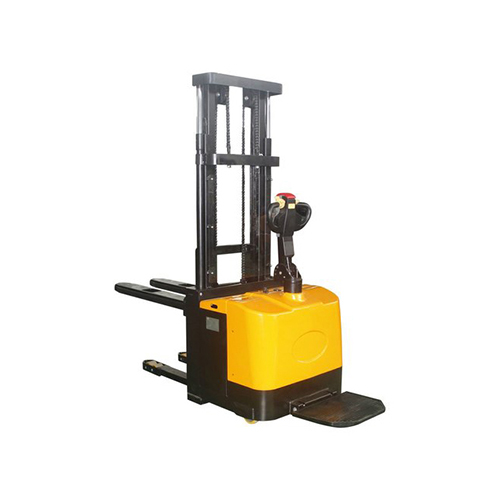
What is a Power Stacker?
A power stacker is a fully electric material handling machine used for lifting and transporting pallets. It features an electric motor for driving the wheels and another motor for the hydraulic lifting system. It is operated by a control handle (tiller) that allows the worker to steer, move, and lift the forks effortlessly. It is designed for high-efficiency stacking in warehouses where loads need to be moved over longer distances and lifted to high storage levels.
By upgrading to a fully powered system, you ensure that your workplace stays productive and safe. These machines are built to handle the tough, dusty conditions of Indian industrial units while providing smooth and precise control. Investing in a powered stacker helps you process orders faster, protect your workers from strain, and make your entire material handling process much more professional.
Problems Faced Without a Power Stacker
- Worker Fatigue: Pushing and pulling heavy loads manually all day leads to extreme tiredness and long-term health issues.
- Slow Stacking Speed: Manual work takes much more time, causing bottlenecks in your production and dispatch areas.
- Unsafe Manual Lifting: Tired workers are more likely to lose control of a load, leading to damaged products or injuries.
- Low Productivity: If your material handling is slow, your entire factory or warehouse cannot reach its full potential.
- High Labor Costs: You often need extra workers just to help push and position manual lifting equipment.
How a Power Stacker Solves These Problems
- Smooth Powered Lifting: The electric motor raises the forks quickly and smoothly, even with the heaviest loads.
- Easy Movement with Heavy Loads: The motorized drive does the pushing, so the operator only has to guide the machine.
- Reduced Physical Effort: One person can manage the entire warehouse without feeling exhausted at the end of the shift.
- Improved Workplace Safety: Features like automatic braking and speed control make it much safer than manual tools.
- Consistent Workflow: The machine works at the same fast speed all day, helping you plan your production more accurately.
Key Features of Power Stacker
Applications & Industrial Uses
Why Choose a Trusted Manufacturer & Supplier
Buying from a professional power stacker manufacturer ensures that you get a machine that is both safe and long-lasting. A reliable power stacker supplier in India provides the high-quality engineering needed for continuous use.
- Manufacturer & Supplier in India: Get a machine designed specifically for Indian industrial conditions and power standards.
- Strong and Durable Build: High-quality components ensure the stacker survives years of heavy daily use.
- Reliable Power System: Advanced batteries and motors that provide consistent performance without frequent breakdowns.
- Local Service Support: Enjoy fast on-site service and easy access to spare parts in Ahmedabad and Gujarat.
More About Power Stacker
The Power Stacker is the top-tier choice for any modern business in India. When comparing different types of lifting equipment, the power stacker stands out because it is “fully electric.” While a manual stacker requires human power for everything, and a semi-electric model only helps with lifting, the power stacker handles both movement and lifting. This makes it the best choice for large facilities where workers have to travel long distances between the loading dock and the storage racks.
For a warehouse manager in Ahmedabad, the return on investment for a power stacker is very clear. Because the machine moves so quickly, one person can do the work of three people using manual equipment. This saves a huge amount of time every single day. Also, because the movement is controlled by a motor, there is much less chance of a load bumping into a wall or a machine, which saves money on repairs and product damage.
Safety is also a major reason why industries are switching to powered systems. These machines come with “belly-buttons” or safety reverse switches that protect the operator from being pinned against a wall. They also have speed limits to ensure they don’t move too fast in crowded areas.
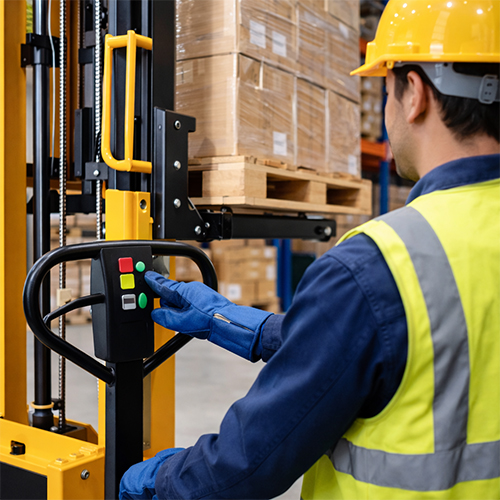
In the long run, a power stacker is not just a tool—it is a partner that makes your business more efficient, keeps your team safe, and helps you handle a much higher volume of work every day.
Technical Specification
| Product Code | VI 118 | |
| Drive: electric(battery or mains) | Electric | |
| Type of operation :hand , pedestrian, standing, seated, order-picker | Pedestrian | |
| Load Capacity /rated load | Q (T) | 1.3 |
| Load center distance C | C (MM) | 600 |
| Load distance ,center of drive axle to fork | X (MM) | 413 |
| Wheelbase | Y (MM) | 1255 |
| Weights | ||
| Service weight | KG | 1850 |
| Axle loading, laden front/rear | KG | 1500 / 1650 |
| Axle loading,unladen front/rear | KG | 1495 / 525 |
| Wheels, Chassis | ||
| tyre : Solid rubber, Superelastic, Pneumatic, Polyurethane | Polyurethane | |
| Tyre size, front | MM | 230 x 70 |
| Tyre size, rear | MM | 210 x 85 |
| Additional wheels(dimensions) | MM | 150 x 54 |
| Wheels, number front/rear(x=driver wheels) | 1x +2/ 2/1x +2/ 4 | |
| Track width,front | b10 (MM) | 620 |
| Track width,rear | b11 (MM) | 993 |
| Basic Dimensions | ||
| Mast/fork carriage tilt forward/backward | a | 2/4 |
| Lowered mast height | h1 (MM) | 2276 |
| Free lift | h2 (MM) | 1750 |
| Lift height | h3 (MM) | 1750 |
| Extended mast height | h4 (MM) | 2663 |
| Height of tiller in drive position min./max. | h14 (MM) | 984 / 1365 |
| Lowered height | h13 (MM) | 50 |
| Overall length | l1 (MM) | 2265 |
| Length to face of forks | l2 (MM) | 1115 |
| Overall width | b1 (MM) | 1104 |
| Fork dimension s/e/l | MM | 35/100/950(1150) |
| Width over forks | b5 (MM) | 200~720 |
| Distance between supports arms/loading surfaces | b4 (MM) | 784 |
| Reach distance | l4 (MM) | 550 |
| Ground clearance, center of wheelbase | m2 (MM) | 59 |
| Aisle width for pallets 1000 X 1200 Crossways | Ast (MM) | 2632 |
| Aisle width for pallets 800 X 1200 lengthways | Ast (MM) | 2675 |
| Turning radius | Wa (MM) | 1593 |
| Length across wheel arms | l7 (MM) | 1651 |
| Performance | ||
| Travel speed, laden/unladen | KM/H | 5.0 / 5.5 |
| Lift speed, laden/unladen | MM/S | 85 / 122 |
| Lowering speed, laden/unladen | MM/S | 120 / 80 |
| Max.gradient performance, laden/unladen | % | 41856 |
| Service brake | Electromagnetic | |
| E-Motor | ||
| Drive motor rating s2 60 min | KW | 1.8 |
| Lift motor rating at s3 15% | KW | 2.2 |
| Battery acc. To DIN, no | 3PZS | |
| Battery voltage, nominal capacity | V/Ah | 24/270 |
| Others | ||
| Type of drive control | MOSFET Control | |
| sound level at drivers ear acc.to EN 12053 | dB(A) | 67 |