
In many Indian warehouses and small factories, lifting heavy pallets onto racks or into trucks is a daily challenge. A Manual Hydraulic Stacker is the most cost-effective solution for businesses that need to stack goods vertically without the high price tag of a forklift. This equipment is designed to be pushed by hand, while a simple hydraulic pump does the heavy lifting. Whether you are managing a small godown or a busy production unit in Ahmedabad, Gujarat, a stacker is an essential tool for keeping your workspace organized.
Lifting heavy crates or bags manually is not just slow; it is extremely risky. In the competitive industrial hubs of India, worker safety is a top priority. Without a proper lifting machine, staff members often suffer from back strain and other injuries, leading to lost work hours. A hydraulic stacker removes this physical burden, allowing a single person to lift and stack Loads of up to 1.5 tons safely and efficiently.

What is a Manual Hydraulic Stacker?
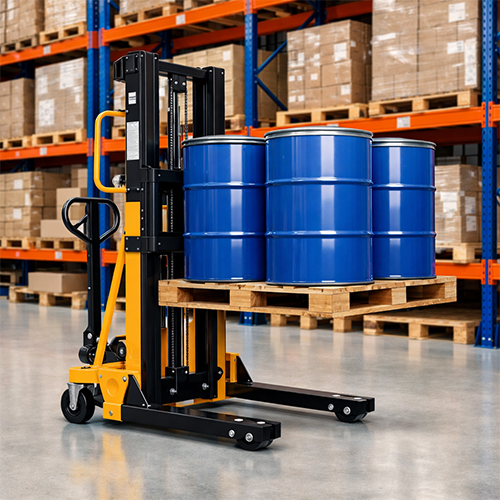
A manual hydraulic stacker is a versatile material handling machine used to lift, stack, and move palletized goods. It features a sturdy steel mast, two forks at the front, and a manual hydraulic pump system. To lift a load, the operator simply uses a hand lever or a foot pedal to pump the hydraulic fluid, which raises the forks. It is a compact and eco-friendly alternative to electric forklifts, making it perfect for short-distance transport and vertical stacking on flat floors.
By choosing a high-quality manual stacker, you ensure that your goods are handled with care and your team remains protected. These machines are built to be rugged and reliable, fitting perfectly into the fast-paced environment of Indian factories where space is often limited and efficiency is key.
Problems Faced Without a Manual Hydraulic Stacker
- Worker Fatigue and Back Pain: Lifting heavy loads manually day after day leads to serious health issues for your workers.
- Unsafe Manual Lifting: Without a stable lift, there is a high risk of loads falling and causing accidents.
- Slow Stacking Process: Stacking goods by hand or with makeshift tools takes much longer, slowing down your entire dispatch.
- Damage to Goods: Dropping items during manual handling can lead to broken products and financial losses.
- High Labor Costs: You often need three or four people to move what a single person can handle with a stacker.
How a Manual Hydraulic Stacker Solves These Problems
- Smooth Hydraulic Lifting: The hydraulic pump allows for controlled lifting, ensuring the load moves up steadily.
- Better Control of Loads: You can lower the pallet precisely to the inch, preventing bumps and damage.
- Reduced Physical Effort: The machine carries the weight, so your workers don’t have to strain their muscles.
- Improved Workplace Safety: Built-in brakes and a sturdy frame keep the machine stable while lifting heavy items.
- Saves Space: Its small turning radius allows it to work in narrow aisles where larger machines cannot enter.
Key Features of Manual Hydraulic Stacker
Applications & Industrial Uses
These trucks are essential in various heavy industries across India:
Why Choose a Trusted Manufacturer & Supplier
Investing in a stacker from a well-known manual hydraulic stacker manufacturer ensures you get a machine that is built to last. A trusted manual hydraulic stacker supplier in India will offer a product that meets local industrial standards.
- Strong and Durable Construction: Made to handle the tough conditions of Indian workshops.
- Easy Maintenance: Simple designs that are easy to oil and service without expensive tools.
- Local Service Support: Fast access to spare parts and technicians in Ahmedabad and Gujarat.
- Reliable Performance: Certified manufacturers test their machines to ensure they can carry the rated load safely.
More About Manual Hydraulic Stacker
The Manual Hydraulic Stacker is a favorite among small business owners in India for a very simple reason: it offers the best return on investment. While fully electric forklifts are powerful, they are also very expensive and require regular battery charging and specialized technicians. For a small warehouse in Ahmedabad, a manual stacker provides 80% of the same utility at a fraction of the cost.
These machines are incredibly easy to use. Most operators can learn to use a stacker in just a few minutes. Because it has no electric motor, it is virtually silent and doesn’t produce any fumes, making it safe for indoor use in small rooms. It is also very compact. In many Indian godowns, the aisles are too narrow for a truck, but a stacker can turn easily in small spaces to reach the highest shelf.
Furthermore, the long-term value of a manual stacker is excellent. Since there are no complex electronics or batteries to replace, the maintenance costs are almost zero.As long as the hydraulic oil is checked and the wheels are kept clean, a high-quality stacker from a reliable manufacturer can easily last for over 10 years. It is a one-time investment that helps your business grow by making your daily operations faster, safer, and much more professional.
Technical Specification
| Product Code | VI 113 | |
| Rated Capacity | Tons | 1 / 1.5 |
| Load Center | MM | 600 |
| Max. Fork Height | MM | 1600 / 2000 |
| Fork Length | MM | 1150 |
| Fork Width | MM | 550/600/300-850 |
| Turning Radius | MM | 1500 |
| Wheelbase | MM | 1100 |
| Front Wheel Distance | MM | |
| Overall Length | MM | 1500 |
| Overall Width | MM | 400 – 865 |
| Overall Height | MM | 2100 |
| Self Weight | KG | 150 |