How to Choose the Right Reel Pallet Truck for Industrial Material Handling
Moving a standard pallet is simple because the load has a flat and stable base. Handling a reel, roll, or drum is different. Its round shape can make conventional pallet handling difficult and may increase the chance of the load shifting or rolling during movement.
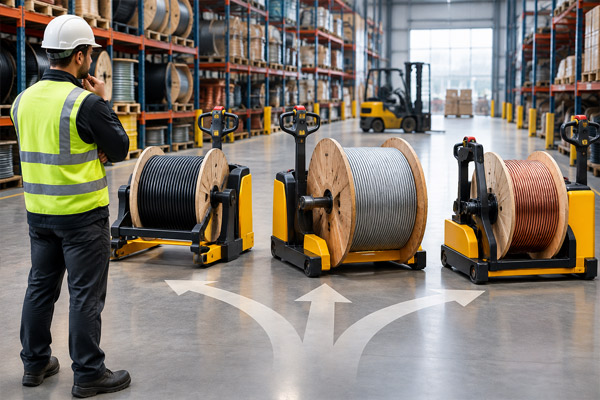
A Reel Pallet Truck is designed specifically for handling cylindrical loads. It can be useful in factories, warehouses, printing units, textile operations, cable industries, packaging facilities, and other industrial environments where reels and rolls need to be moved regularly. Vision Industries also identifies reel pallet trucks as a specialized solution for handling reels, rolls, and drums.
But simply buying a reel pallet truck is not enough. You need to select one according to the reel size, load weight, floor condition, available working space, and frequency of use.
This guide explains the practical factors to consider when choosing a Reel Pallet Truck for industrial material handling.
What Is a Reel Pallet Truck?
A Reel Pallet Truck is a specialized material handling truck designed to lift and move cylindrical loads that may not sit safely on the flat forks of a standard pallet truck.
Depending on the application, it can be used for handling materials such as:
- Cable reels
- Wire reels
- Paper rolls
- Fabric rolls
- Packaging rolls
- Industrial reels
- Cylindrical drums
- Other round loads
The fork arrangement is designed to support the curved shape of the load and help reduce unwanted rolling during movement.
Why Is a Reel Pallet Truck Useful?
Imagine trying to move a large industrial reel using equipment designed only for rectangular pallets. Even if the load can be lifted, keeping it stable can become difficult.
This is where purpose-built reel handling equipment becomes useful.
A suitable Reel Pallet Truck can help with:
- Easier movement of cylindrical loads
- Better load stability
- Reduced manual handling
- Faster internal material movement
- More controlled reel transportation
- Reduced chances of the reel rolling during movement
- Better workflow between production and storage areas
Vision Industries categorizes Reel Pallet Trucks specifically for rolls, reels, and drums, highlighting the role of specialized equipment in preventing cylindrical loads from slipping or rolling.
How to Choose the Right Reel Pallet Truck?
Choosing the right model starts with understanding the material you actually need to move.
Here are the most important factors to check.
1. Know the Type of Reel You Need to Handle
Start with a simple question:
What exactly will you move with the pallet truck?
A cable reel and a paper roll may have completely different dimensions, weights, surfaces, and handling requirements.
Before contacting a manufacturer, identify:
- Type of reel or roll
- Material
- Diameter
- Width
- Weight
- Frequency of movement
Giving this information to the manufacturer makes it easier to recommend an appropriate configuration.
2. Check the Maximum Load Weight
Load capacity is one of the most important considerations.
Do not select equipment according to the average load alone.
Suppose most of your reels weigh 600 kg but some regularly reach 900 kg. Selecting the truck only around the 600 kg requirement would not reflect your real operating conditions.
Know your:
Minimum load → Average load → Maximum load
Then discuss the maximum expected load with the manufacturer.
Never exceed the rated load capacity of the equipment.
3. Measure the Reel Diameter
Unlike standard pallets, reels can have significantly different diameters.
The reel diameter affects how the load sits between or over the supporting forks.
Measure the smallest and largest reel diameters handled in your facility.
This becomes especially important when one truck needs to handle several reel sizes.
Before purchasing, tell the supplier:
- Minimum reel diameter
- Maximum reel diameter
- Reel width
- Reel weight
This helps determine whether one configuration can cover your normal operating range.
4. Check Reel Width
Diameter is not the only measurement that matters.
The width of the reel should also be considered.
A narrow cable reel may require different support compared with a wide paper or textile roll.
If the truck does not suit the reel dimensions, the load may not sit in the intended position.
Measure your existing reels rather than relying on estimated sizes.
5. Understand the Fork Design
A standard pallet truck generally uses straight forks designed to enter underneath a pallet.
A Reel Pallet Truck needs a configuration suitable for supporting a cylindrical load.
This is one of the main reasons you should avoid choosing equipment based only on overall capacity.
Discuss the fork design according to:
- Reel diameter
- Reel width
- Load weight
- Material type
- Loading position
The goal is to keep the reel properly supported during lifting and movement.
6. Consider Your Floor Condition
A pallet truck works directly on the floor, so floor quality matters.
Check whether your facility has:
- Smooth concrete floors
- Industrial flooring
- Epoxy floors
- Floor joints
- Uneven sections
- Small slopes
- Loading areas
Smooth industrial floors generally make manual movement easier.
If the truck will operate over uneven surfaces, slopes, or unusual flooring, tell the manufacturer before purchase.
Vision Industries offers different pallet truck configurations for specific working conditions, including reel and rough-terrain applications.
7. Measure Aisle Width and Turning Space
Factories sometimes focus only on load capacity and forget about available movement space.
Before purchasing a Reel Pallet Truck, measure:
- Warehouse aisle width
- Production aisle width
- Door openings
- Storage areas
- Turning points
- Machine-to-machine pathways
- Loading and unloading areas
The truck should be able to enter, turn, load, and move safely within the available space.
This becomes particularly important in older factories or facilities with closely positioned machinery.
8. Consider Daily Usage Frequency
How often will the truck be used?
There is a major difference between moving five reels per day and moving dozens of reels throughout a production shift.
Consider:
- Number of reels moved daily
- Distance travelled per movement
- Number of operators
- Number of working shifts
- Average load weight
- Production cycle
Higher-frequency applications may require a more robust configuration.
Reel Pallet Truck for Cable and Wire Industry
Cable and wire manufacturers frequently work with reels of different sizes.
These reels may need to move between:
Production → Winding → Inspection → Storage → Dispatch
Manually handling heavy cable reels can be slow and physically demanding.
A properly selected Reel Pallet Truck can make internal reel movement more organized and reduce dependence on manual lifting.
Reel Pallet Truck for Paper and Printing Industry
Paper rolls are another common cylindrical load.
Printing and paper-related facilities may need to move rolls between storage, printing, converting, and production areas.
A Reel Pallet Truck can be useful when the roll dimensions and truck configuration are compatible.
Before buying, share the paper roll’s:
- Diameter
- Width
- Weight
- Storage method
- Movement frequency
These details help determine a suitable material handling solution.
Reel Pallet Truck for Textile Industry
Textile facilities may handle fabric rolls and other rolled materials throughout production.
The material may need to move between storage, processing, inspection, packing, and dispatch.
Vision Industries lists the textile sector among the industries served by its material handling equipment range.
Using purpose-built handling equipment can help make repeated internal material movement easier and more controlled.
Reel Pallet Truck for Warehouses
Warehouses storing cylindrical products face a different challenge from facilities that handle only standard pallets.
Reels may need to be moved between:
- Receiving areas
- Storage locations
- Production supply areas
- Inspection points
- Packing sections
- Dispatch areas
A Reel Pallet Truck can provide a simple solution when the load does not require high-level stacking and mainly needs horizontal movement.
What Should You Check Before Buying?
- Rated load capacity
- Load centre
- Fork dimensions
- Overall width
- Turning radius
- Battery specification
- Operating duration
- Travel speed
- Lift speed
- Tyre material
- Charging requirements
- Safety features
- Warranty
- Spare parts
- Service support
This simple checklist can help avoid buying a machine that does not match your warehouse.
Reel Pallet Truck vs Standard Pallet Truck
Both machines move loads, but they are designed for different load shapes.
| Feature | Reel Pallet Truck | Standard Pallet Truck |
|---|---|---|
| Main load | Reels, rolls and cylindrical loads | Standard pallets |
| Load shape | Round or cylindrical | Flat palletized loads |
| Fork design | Designed around reel handling | Standard straight pallet forks |
| Common application | Cable, paper, textile and roll handling | General warehouse movement |
| Load stability | Supports cylindrical-load handling | Best suited to stable pallets |
| Selection factor | Reel diameter, width and weight | Pallet size and weight |
If your business mainly moves standard pallets, a regular pallet truck may be sufficient.
If cylindrical loads are part of your daily operation, specialized reel-handling equipment can be a better choice.
What Size Reel Pallet Truck Should You Choose?
There is no single size that is ideal for every industry.
The correct size depends on the combination of:
Reel Diameter + Reel Width + Load Weight + Working Space + Daily Usage
For example, a company moving smaller cable reels may have completely different requirements from a facility moving large industrial paper rolls.
That is why measurements should be taken before requesting a quotation.
Can One Reel Pallet Truck Handle Different Reel Sizes?
Potentially, but only within the equipment’s designed operating range.
If your facility handles different reel sizes, prepare a simple list such as:
| Requirement | Smallest Reel | Largest Reel |
|---|---|---|
| Diameter | Actual measurement | Actual measurement |
| Width | Actual measurement | Actual measurement |
| Weight | Actual weight | Actual weight |
Share these details with the manufacturer.
This is much more useful than simply asking, “Which Reel Pallet Truck is best?”
What Should You Check Before Buying a Reel Pallet Truck?
Before placing an order, confirm:
- Maximum load capacity
- Minimum reel diameter
- Maximum reel diameter
- Reel width
- Fork configuration
- Overall truck dimensions
- Turning requirement
- Wheel type
- Hydraulic mechanism
- Floor suitability
- Daily operating frequency
- Spare-parts availability
- Maintenance support
- Warranty terms
Also explain your actual application rather than selecting equipment only from a catalogue image.
How to Choose a Reel Pallet Truck Manufacturer in Ahmedabad
If you are searching for a Reel Pallet Truck Manufacturer in Ahmedabad, look beyond price.
A good manufacturer should first understand what you need to move.
Share information about your reel dimensions, weight, floor condition, movement distance, and daily workload.
Look for a manufacturer that can provide:
- Application-based guidance
- Clear equipment specifications
- Suitable load capacity
- Appropriate reel-handling configuration
- Industrial construction
- Spare-parts support
- Maintenance guidance
- After-sales assistance
Vision Industries manufactures a range of material handling equipment from Ahmedabad, including Reel Pallet Trucks alongside standard, heavy-duty, weighing-scale, rough-terrain, and battery-operated pallet trucks.
Reel Pallet Truck Supplier in Ahmedabad for Industrial Applications
Choosing a local Reel Pallet Truck Supplier in Ahmedabad can be useful for companies operating in Ahmedabad’s industrial areas.
Local coordination can make it easier to discuss:
- Application requirements
- Equipment configuration
- Technical questions
- Service
- Maintenance
- Spare parts
Vision Industries states that it supplies and services material handling equipment across major industrial areas in Gujarat, including Naroda, Odhav, Vatva, Kathwada, and Sanand around Ahmedabad.
For buyers, the important point is to select the equipment based on the application rather than location alone.
Choosing a Reel Pallet Truck Exporter in Ahmedabad
Export buyers should consider more than the machine itself.
Before finalizing an order with a Reel Pallet Truck Exporter in Ahmedabad, discuss:
- Required load capacity
- Reel dimensions
- Technical specifications
- Packing requirements
- Documentation
- Spare parts
- Maintenance requirements
- Destination-specific requirements
Providing complete application details at the enquiry stage can reduce confusion later.
Is a Reel Pallet Truck Worth Buying?
A Reel Pallet Truck can be a practical investment if your facility moves cylindrical loads regularly.
It is especially worth considering when:
- Reels are too heavy for comfortable manual movement
- Round loads are difficult to control
- Reel movement happens several times per day
- Workers spend too much time handling rolls manually
- Production and storage areas are separated
- You want a dedicated solution for cylindrical loads
For occasional movement of very small and light rolls, specialized equipment may not always be necessary.
The decision should be based on your actual workload.
Conclusion
Choosing the right Reel Pallet Truck starts with understanding your load.
Do not focus only on capacity or price. Check the reel diameter, reel width, maximum weight, fork configuration, floor condition, aisle width, turning space, wheels, hydraulic mechanism, and daily operating frequency.
A well-matched Reel Pallet Truck can make the movement of cable reels, paper rolls, fabric rolls, drums, and other cylindrical materials easier and more controlled.
For businesses searching for a Reel Pallet Truck Manufacturer in Ahmedabad, Vision Industries provides reel pallet trucks as part of its broader material handling equipment range for industrial applications.
Frequently Asked Questions
A Reel Pallet Truck is specialized material handling equipment designed to lift and move cylindrical loads such as reels, rolls, and drums.
You should know the reel diameter, reel width, maximum weight, daily movement frequency, floor condition, aisle width, and travel distance.
Yes, a properly selected Reel Pallet Truck can be used for cable and wire reels. The truck configuration should match the reel’s dimensions and weight.
They can be suitable for paper-roll handling when the equipment is designed for the roll’s diameter, width, and weight.
A standard pallet truck is primarily designed for flat palletized loads, while a Reel Pallet Truck is configured for round or cylindrical loads such as reels and rolls.
It may handle different reel sizes when those sizes fall within its designed range. Give the manufacturer your minimum and maximum reel dimensions before ordering.
They can be useful in cable and wire, paper, printing, textile, packaging, manufacturing, and warehouse operations where cylindrical loads need to be moved.
Determine the maximum reel weight handled in your facility and discuss it with the manufacturer. Do not select capacity based only on the average load.
Vision Industries manufactures Reel Pallet Trucks and other material handling equipment in Ahmedabad for industrial applications.
Ask about load capacity, supported reel dimensions, fork configuration, wheel type, maintenance, spare parts, warranty, and suitability for your actual working conditions.