What Is the Main Difference Between a Semi Electric and Manual Stacker?
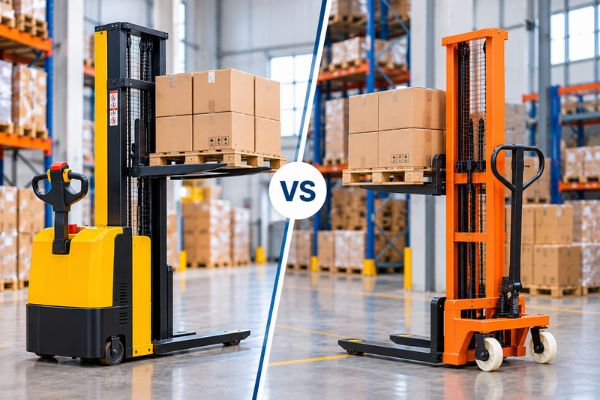
A semi electric stacker uses battery power to lift and lower goods, while the operator usually pushes and steers it by hand. A manual stacker uses a hand or foot pump for lifting and also needs manual movement. Choose a semi electric stacker when repeated lifting takes too much effort or slows your work.
Picking a stacker becomes easier when you look at daily tasks. How heavy are your pallets? How often do workers lift them? How far must the stacker travel? These details help you decide whether powered lifting will solve the problem.
A manual stacker may be enough for occasional work. A semi electric operated stacker can be more suitable when lifting is frequent, but travel distances remain short. This guide explains how to compare both options before buying.
How Does a Manual Stacker Work?
An electric hydraulic lift uses an electric motor to run a pump. The pump sends hydraulic oil into a cylinder, which raises the platform. A control valve manages the oil flow when the platform lowers.
In factories and warehouses, hydraulic goods lifts help move materials between floor levels. Common loads include:
- Occasional pallet lifting
- Moving goods within a small stockroom
- Supporting light material handling tasks
- Loading goods onto suitable raised work areas
- Handling pallets where use is infrequent
A manual stacker does not need a battery for lifting. However, workers must provide the effort needed to pump, steer and move the equipment.
How Does a Semi Electric Operated Stacker Work?
A semi electric operated stacker generally uses a battery, electric motor and hydraulic pump to lift the forks. The operator controls lifting through buttons or another control system.
Movement is usually manual. Powered lifting reduces pumping effort, but it does not remove the effort needed to move a loaded stacker.
This distinction matters when choosing equipment. A semi electric stacker may improve a repeated lifting task while doing little to solve a long travel route.
Before buying, ask the supplier to confirm:
- Which functions are powered
- How the stacker moves
- How lifting and lowering are controlled
- Battery and charger specifications
- Braking arrangements
- Suitable working surfaces
Product names vary between suppliers. Check the actual functions of the quoted model.
When Is a Manual Stacker Enough?
A manual stacker can be suitable when lifting is occasional, distances are short and workers can handle the task comfortably.
For example, a small stockroom may need to lift a few pallets during receiving or dispatch. If the equipment matches the load and layout, powered lifting may offer limited benefit.
Consider a manual stacker when:
- Pallet lifting happens infrequently
- Loads stay within the model’s rated limits
- Movement is over short, clear routes
- Floors are firm, smooth and level
- Lifting time does not delay other work
- A suitable manual model fits the pallets
Do not choose a manual stacker only because it costs less. Check whether the task can be completed without excessive effort.
When Should You Choose a Semi Electric Stacker?
Choose a semi electric stacker when lifting is repeated often enough to cause fatigue or delay work, while manual travel remains manageable.
The strongest reason to upgrade is a clear problem in the current process. Powered lifting should address that problem.
When repeated pumping tires workers
Manual pumping takes effort during every lift. If workers repeat the task throughout a shift, fatigue can build.
Battery powered lifting removes the repeated pumping task. Workers still need to position pallets, move the stacker and follow safe handling procedures.
When lifting slows receiving or dispatch
If workers spend too much time pumping pallets to the required height, goods may queue near the handling area.
A suitable semi electric stacker can reduce the manual work involved in raising the forks. Ask for a demonstration with your usual load to assess the actual lifting speed.
When goods need frequent height changes
Some tasks involve lifting and lowering goods many times at the same location. Powered lifting can make these adjustments easier.
Examples include transferring pallets between floor level and suitable storage positions or presenting materials at different working heights.
When travel routes are short
Semi electric stackers often suit work concentrated around a receiving area, storage bay or production station.
If the stacker must travel long distances with heavy loads, manual movement may remain the main difficulty. In that case, compare equipment with powered travel.
Semi Electric Stacker vs Manual Stacker
| Comparison Point | Manual Stacker | Semi Electric Stacker |
|---|---|---|
| Lifting Method | Hand or foot operated hydraulic pump | Battery powered lifting |
| Travel Method | Usually manual | Usually manual |
| Repeated Lifting Effort | Requires repeated pumping | Reduces pumping effort |
| Battery Charging | Not needed for lifting | Required |
| Purchase Cost | Often lower for comparable models | Often higher for comparable models |
| Maintenance Needs | Hydraulic system, wheels, forks and other parts | Similar checks plus battery, charger and electrical parts |
| Suitable Use | Occasional lifting over short routes | More frequent lifting over short routes |
| Long Distance Movement | Can require substantial effort | Can still require substantial effort |
| Pallet Compatibility | Must be checked | Must be checked |
The better choice depends on the task and the specific model. Capacity, lifting height and layout still need checking for both types.
How Do Load Capacity and Lifting Height Affect Your Choice?
Select capacity and lifting height together. A stacker’s ability to carry a load may change at greater heights or with a different load position.
Start with the total weight of:
- Goods
- Pallet
- Packaging
- Containers or attachments carried with the load
For example, goods weighing 700 kg on a 40 kg pallet create a total load of 740 kg. Share the complete weight with the supplier.
Also measure the height needed to place the pallet. The forks must reach a suitable position for loading and unloading.
Ask for the model’s capacity chart or load information. Confirm the allowed weight at your required height and load centre. The load centre describes how far the load’s centre of weight sits from the fork face.
Do not assume the headline capacity applies at every height or for every pallet.
Will the Stacker Fit Your Pallets?
Pallet compatibility should be checked before placing an order. A stacker can have enough capacity and still be unable to pick up your pallet correctly.
Some designs have support legs that must enter beneath or around the pallet. The pallet’s bottom boards and openings can affect access.
Give the supplier:
- Pallet length and width
- Photos of the top and underside
- Fork entry opening dimensions
- Details of bottom boards
- Loaded pallet weight
- Any load overhang
Ask whether the quoted model needs open bottom pallets or a different support leg arrangement.
A demonstration using your actual pallet is useful. Check pickup, lifting, turning and placement at the required location.
Can a Semi Electric Stacker Work in Narrow Aisles?
A semi electric stacker may suit a compact warehouse, but aisle suitability must be checked using the full equipment and load dimensions.
The stacker needs space to turn, approach the pallet and line up with the storage position. Its body width alone does not show the required working space.
Check:
- Aisle width
- Turning space
- Loaded pallet dimensions
- Support leg position
- Rack access
- Door openings
- Operator space
Ask the supplier for the working aisle requirement for your pallet size. Test the intended manoeuvre where possible.
Also check the stacker’s lowered mast height against doors and its raised mast height against ceilings, beams and other obstructions.
How Do Floor Conditions and Travel Distance Affect Performance?
Floor conditions affect the effort needed to move either stacker. Powered lifting does not solve problems caused by difficult travel surfaces.
Cracks, uneven joints, debris and floor damage can make movement harder. These conditions may also affect load stability.
Before choosing a stacker:
- Walk the full travel route.
- Measure the distance between pickup and placement.
- Check floor joints and damaged areas.
- Identify slopes, thresholds and tight turns.
- Discuss the route with the supplier.
Confirm that the equipment is suitable for the surface and route. Do not assume it can operate on a ramp because it works on a level warehouse floor.
If loaded movement remains difficult during a trial, consider powered travel equipment or a change to the layout.
What Battery and Charging Details Should You Check?
A semi electric stacker needs a charging plan that fits your working hours. Battery performance depends on the battery type, condition, load and amount of lifting.
Ask the supplier about:
- Battery type and capacity
- Charger supplied with the model
- Required electrical connection
- Expected performance for your lifting task
- Charging instructions
- Battery replacement availability
- Battery and charger warranty
Avoid choosing based on a broad claim that the battery lasts a full shift. Explain your expected lifts, loads and operating hours.
Plan a suitable charging area and follow the manufacturer’s instructions for the battery type. Confirm who will handle charging and routine checks.
What Should You Compare Beyond the Purchase Price?
Compare the cost of using each stacker as well as its purchase price.
A manual stacker may cost less initially, but repeated pumping can consume working time. A semi electric stacker adds battery and electrical maintenance needs while reducing lifting effort.
| Cost or Work Factor | What to Review |
|---|---|
| Purchase Price | Equipment, delivery, taxes and included accessories |
| Handling Time | Time needed for the same complete task |
| Operator Effort | Pumping and loaded movement |
| Maintenance | Service schedule, parts and visit charges |
| Battery Costs | Replacement terms and availability |
| Downtime | Local support and spare parts |
| Training | Instructions provided during handover |
Use a trial to compare the same task with both options. Include pickup, movement, lifting and placement. This gives a more useful result than timing the lift function alone.
What Should You Ask a Stacker Supplier in Gujarat?
When comparing suppliers in Ahmedabad or elsewhere in Gujarat, ask questions about the proposed model and your site.
Useful questions include:
- Can you demonstrate the stacker with our pallet?
- What load is allowed at our required lifting height?
- Will the support legs fit our pallet design?
- Is the model suitable for our floor and travel route?
- What battery and charger are included?
- Which parts are stocked locally?
- What does the warranty cover?
- Who provides service at our location?
- What training and documents come with handover?
For a product discussion, share your load details, pallet photos, lifting height and warehouse layout with Vision Industries. Request a model proposal based on the complete task.
Conclusion
Choose a semi electric stacker over a manual stacker when repeated lifting creates extra effort or delays work, and manual travel remains practical.
Before buying, confirm load capacity at the required height, pallet compatibility, aisle space and floor suitability. A trial with your actual load can show whether powered lifting solves the problem or whether you also need powered movement.
Frequently Asked Questions
Consider an upgrade when repeated pumping tires workers or slows lifting tasks. Check that manual movement is still suitable for your loads, floors and travel distances.
Usually, a semi electric stacker has powered lifting and manual travel. Confirm the functions of the specific model because supplier naming can vary.
It may be suitable if the load is within the model’s allowed capacity at the required height and load centre. Also assess the effort needed to move the loaded equipment.
No. Pallet openings, bottom boards and support leg design affect compatibility. Ask the supplier to check your pallet or arrange a demonstration.
Operating time varies with battery specifications, condition, load and lifting frequency. Ask the supplier to assess your work pattern and provide a charging plan.
It can suit some compact layouts, but turning and stacking space must be checked. Compare the model’s working aisle requirement with your loaded pallet dimensions.
Confirm capacity, lifting height, pallet fit, aisle space, floor suitability, battery details and service support. Request a written quotation and warranty terms.